

[Author’s Note]
Hello fellow Filipiniana fans,
Earlier this year, Jy and I watched Tanghalang Pilipino’s stage adaptation of Kisapmata (with Virgilio Almario in attendance so we knew we were in for a great show). During the talkback session, Director Guelan Varela-Luarca was asked why he chose to adapt the film. He shared that he considers Kisapmata a great masterpiece and masterpiece adaptations do not need any justification. He said that Mike De Leon’s works should be adapted just like the works of Shakespeare, Rizal and Balagtas. I remember feeling disturbed and impressed by what we saw so I agreed with that statement.
But prior to watching the stage adaptation, the film has been on my watchlist for a while. I’ve read the Nick Joaquin reportage used as the basis for the film, “The House on Zapote Street,” so it felt like it was only a matter of time. A few weeks ago, Jy and I finally watched it. It’s not surprising that it’s considered one of the greatest Filipino films. If you haven’t seen it, it’s currently available in full on YouTube.
Halina!
-Roi
[🎬Film] Kisapmata: A film about a father’s incestuous and controlling relation with his daughter that became an allegory of the Marcos regime
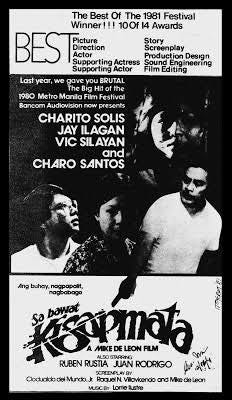
Kisapmata (translation: Blink of an Eye) is a 1981 psychological horror/thriller film directed by Mike de Leon, starring Vic Silayan, Charo Santos, Jay Ilagan, and Charito Solis. A young woman gets married but her domineering father refuses to let her and her new husband out of his control.
The film received much critical acclaim, winning 10 awards including Best Picture at the 7th Metro Manila Film Festival. It is also widely considered to be one of the greatest Filipino films.
The plot was inspired by Nick Joaquin’s “The House on Zapote Street.” The crime reportage chronicles the highly-publicized murder-suicide committed by retired cop, Pablo Cabading. Cabading shot his daughter and his son-in-law before shooting himself. Cabading’s wife Asuncion survived the incident.
Although the real crime happened on January 18, 1961, four years before Ferdinand Marcos Sr. was elected, the film has been interpreted as an allegory of the Martial Law dictatorship.
In his 2022 memoir Last Look Back, Mike de Leon wrote, “Kisapmata explores the concept of strongman rule as exemplified by the character of Dadong, ang Tatang, the psychotic padre de familia, rendered monstrous by the unforgettable performance of Vic Silayan. The father has incestuous relations with his daughter—the ultimate corruption. That the film was interpreted as an allegory of the regime of Ferdinand Marcos was no coincidence, though the crime happened in 1961. Nevertheless, many elements in this allegory were present in the original story. The policeman was an Ilocano, and so was Marcos. He ruled with an iron fist and subjected his family to unmitigated terror, just as Marcos did to the country.”
See our related posts on this topic on our socials (Instagram, TikTok).
Also see related topics: Films, History, Martial Law, Metro Manila Film Festival
In partnership with Host Fria (IG, Tiktok)

Weddings, Corporate Events, Birthdays, kahit Gender Reveal Celebration pa yan, Host Fria can bring the most out of any event.
Host with the MOST!! Host Fria!
Author’s note: we’re grateful to Host Fria for partnering with us to deliver this newsletter to your inbox. With Christmas party season right around the corner, it might serve you well signing up an events host now. Please do check out his IG and TikTok pages if you are looking for a dynamic host for your events. Feel free to let him know you learned about him from Halina Filipiniana — he just might give you a discount ;)